
 EN
EN
In the precision-driven world of peptide manufacturing and distribution, your packaging is the final engineering barrier between a high-value molecule and environmental degradation. Selecting a label supplier is not merely a procurement task; it is a critical step in ensuring product stability, regulatory compliance, and brand integrity.
Peptide vials face extreme conditions—from cryogenic storage at -80°C to repeated exposure to chemical solvents. A standard label will fail, potentially leading to product loss or safety hazards. This guide outlines the 10 key criteria you must use to evaluate peptide label suppliers in 2026.
1. Material Specialization: Cryogenic-Grade Substrates
Peptides are frequently stored in ultra-low temperature freezers or transported via dry ice. Evaluate whether the supplier offers specialized synthetic materials like BOPP (Biaxially Oriented Polypropylene) or Polyester. These materials remain stable and flexible in sub-zero environments, whereas standard paper labels become brittle and crack.
2. Low-Temperature Adhesive Performance
The adhesive must be engineered for "cold-chain" reliability. Look for suppliers providing high-tack, cryogenic acrylic adhesives. These are designed to "wet" the surface of the vial even in the presence of minor frost or condensation, preventing the label from falling off during long-term storage.
3. Chemical and Solvent Resistance
Vials are often sanitized with 70% Isopropyl Alcohol (IPA) or other cleaning agents. A professional supplier must use top-coated materials and UV-cured inks that resist smudging or dissolving when exposed to alcohols and moisture.
4. Mandrel Hold for Small Diameters
Peptide vials are typically small (2ml to 10ml). The label material must have high flexibility and excellent mandrel hold to wrap tightly around a small radius without "winging"—the tendency of the label edges to pop open over time due to material memory.
5. High-Resolution Print Precision
With limited surface area, fonts often drop to 4pt or 5pt. Your supplier must utilize high-resolution digital presses (minimum 1200 DPI) to ensure that critical dosing instructions, barcodes, and lot numbers remain crisp and scannable.
6. Serialization and Variable Data Capabilities
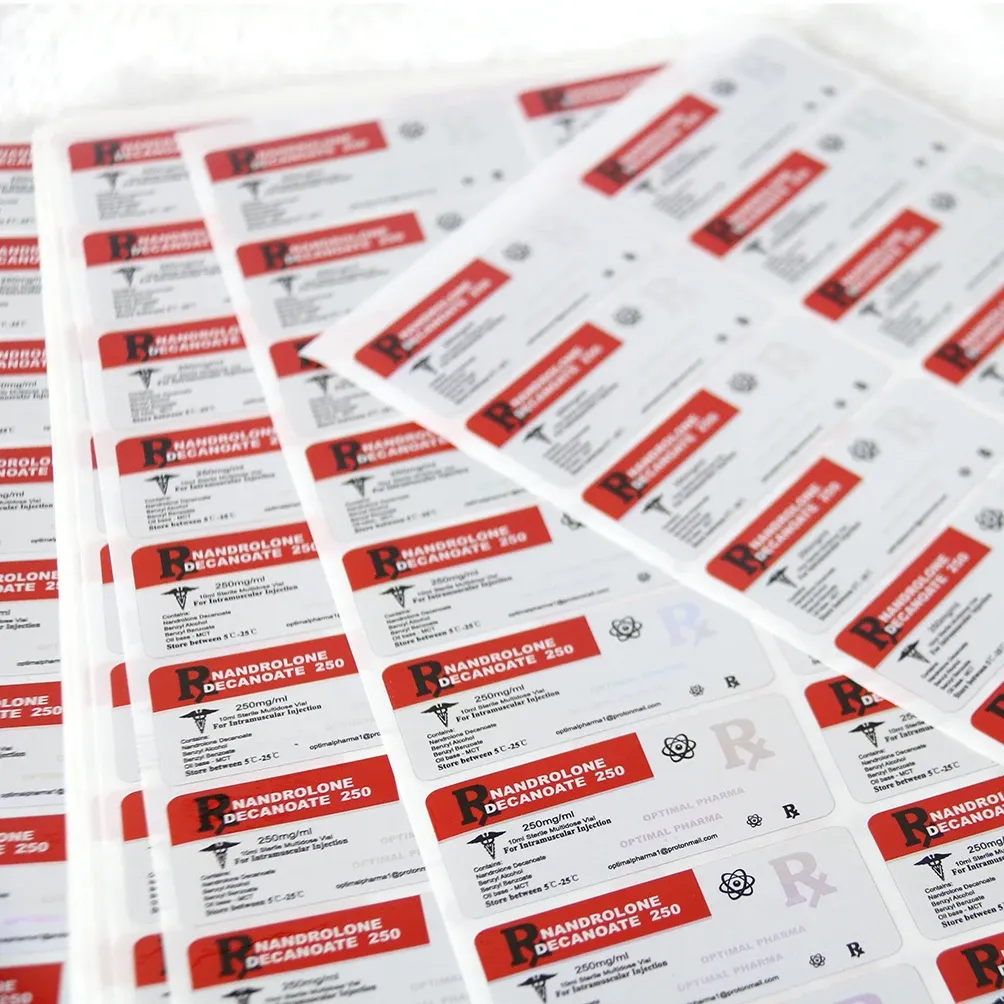
Traceability is a non-negotiable in pharmaceutical supply chains. Ensure the supplier can handle Variable Data Printing (VDP) for unique serial numbers, 2D DataMatrix codes, or QR codes on every individual label to facilitate batch tracking and anti-counterfeit measures.
7. Tamper-Evident and Security Features
To protect against diversion and counterfeiting, look for suppliers who can integrate security elements such as:
Destructible substrates that break upon removal.
Holographic foils or micro-text.
UV-fluorescent inks visible only under blacklight.
8. Cleanroom-Compatible Manufacturing
Particulate contamination can ruin a sterile environment. Inquire if the supplier produces labels in a controlled, dust-free environment and uses plastic cores instead of cardboard to minimize paper dust during application.
9. Regulatory Compliance and Documentation
The supplier should be familiar with ISO 9001:2015 or cGMP standards. They must be able to provide a Certificate of Conformance (CoC) and technical data sheets (TDS) for all materials used, ensuring full traceability for your quality audits.
10. Prototyping and Stability Testing Support
A top-tier supplier won't just take an order; they will provide physical samples for you to perform "real-world" stress tests. This includes applying labels to your specific vials and subjecting them to your actual freeze-thaw cycles and chemical wipe-downs.
Supplier Evaluation Matrix
Use the table below to quickly compare potential partners based on these technical requirements:
Criteria |
Standard Requirement |
Why It Matters |
Material |
Synthetic (BOPP/PET) |
Prevents cracking and moisture absorption in cold storage. |
Adhesive |
Cryogenic Acrylic |
Ensures labels stay attached at -20°C to -80°C . |
Print Quality |
≥ 1200 DPI |
Essential for legibility of tiny text on 2ml vials. |
Durability |
Solvent Resistant |
Prevents ink from smearing when wiped with 70% IPA. |
Compliance |
ISO/cGMP Certified |
Critical for regulatory audits and product safety. |
Table of Contents
- 1. Material Specialization: Cryogenic-Grade Substrates
- 2. Low-Temperature Adhesive Performance
- 3. Chemical and Solvent Resistance
- 4. Mandrel Hold for Small Diameters
- 5. High-Resolution Print Precision
- 6. Serialization and Variable Data Capabilities
- 7. Tamper-Evident and Security Features
- 8. Cleanroom-Compatible Manufacturing
- 9. Regulatory Compliance and Documentation
- 10. Prototyping and Stability Testing Support